Might Be About to Trip Over New Physics and Possibly Their Own Shoelaces
So, picture this: You’re cleaning out your garage, and instead of finding that old lawnmower, you stumble upon a secret doorway to a parallel universe where socks don’t disappear in the laundry. That’s basically what physicists at CERN are doing right now, except their garage is a 27-kilometre-long underground tunnel straddling France and Switzerland, and the secret doorway might be a crack in the very laws of physics. Just your average Tuesday for people who drink espresso and talk about quarks like they’re old friends.

These brilliant folks have been smashing protons together at the Large Hadron Collider (LHC) with the enthusiasm of toddlers playing with priceless Lego sets, hoping to find something that breaks the Standard Model—the universe’s user manual that’s been gathering dust since the 1970s. And guess what? They might have finally found a dent in the cover.
It all starts with a particle called the B meson, which is basically the awkward teenager of the subatomic world. It does this thing called a “penguin decay”—and no, that’s not a typo or a fever dream. Scientists actually named it that because the trails of particles sort of resemble a penguin if you squint, tilt your head, and maybe have had one too many espressos. It’s the cutest name in physics since “quark,” and I’m fully here for it.
Now, this penguin decay is incredibly rare. We’re talking about odds similar to finding a four-leaf clover while being struck by lightning, while winning the lottery. Out of every million B mesons, only one will pull off this penguin move. But when it does, the particles seem to be dancing to a completely different beat than the Standard Model predicted. Is the chance that this is just a cosmic coincidence? Roughly one in 16,000. That’s not quite the “five sigma” gold standard, which would be a one in 1.7 million chance, or basically “you’re more likely to get hit by a meteor while singing karaoke”, but it’s enough to make physicists sit up straight and spill their cappuccinos.
This isn’t just one lonely experiment crying wolf, either. An independent experiment called CMS, also at the LHC, released results earlier in 2025 that point in the same direction. They’re not as precise as the LHCb findings, but they’re nodding along in agreement, like two strangers on a train who realise they both saw the same weird thing out the window. That kind of consistency is what gets scientists excited—and a little nervous.
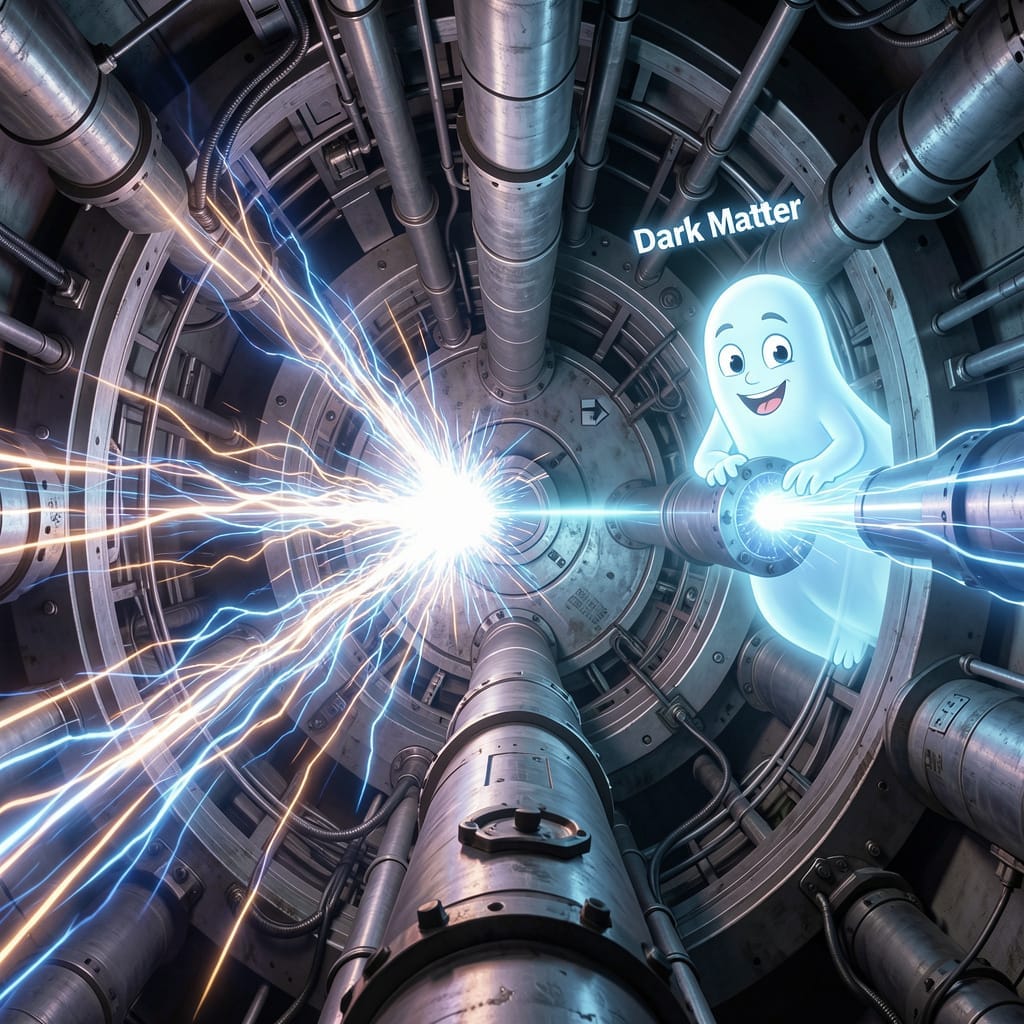
So what does this mean for you, the non-physicist who just wants to know why your phone battery dies instantly? Well, if this pans out, it could explain some of the universe’s biggest head-scratchers. Like, why is gravity so ridiculously weak compared to the other forces? Seriously, a fridge magnet can beat the entire Earth’s gravitational pull. It could also solve the mystery of dark matter, that invisible stuff that makes up about 25% of the universe but has been playing hide-and-seek with scientists for decades. And maybe just maybe it’ll help us figure out why the universe is expanding faster than our to-do lists.
But let’s not throw a quark party just yet. The current results have a pesky complication called “charming penguins.” No, that’s not a new animated movie. It’s a set of processes within the Standard Model that are messy and hard to predict. Recent calculations suggest these charming penguins aren’t strong enough to explain the data. Until more evidence rolls in, physicists are cautiously optimistic, like someone who found a winning lottery ticket but hasn’t checked the expiration date.
The LHCb experiment has already collected three times as much B-meson data since the first batch, and by the 2030s, they plan to have 15 times as much. That’s enough data to fill a hundred thousand swimming pools with ones and zeros. With that kind of firepower, they can either confirm a new era of physics or admit they’ve been chasing a really stubborn measurement error. Either way, it’s going to be a wild ride.

In the meantime, let’s take a moment to appreciate that somewhere in a subterranean Swiss facility, grown adults in lab coats are getting genuinely thrilled about particles shaped like flightless birds. Science is weird, wonderful, and occasionally adorable. And if the universe is going to rewrite its own rules, it might as well do it with a little whimsy.
Hope you had as much fun reading this as we did making it! You can support us by clicking here and checking out one of our songs.
Leave a Reply