By the Geopolitical Desk
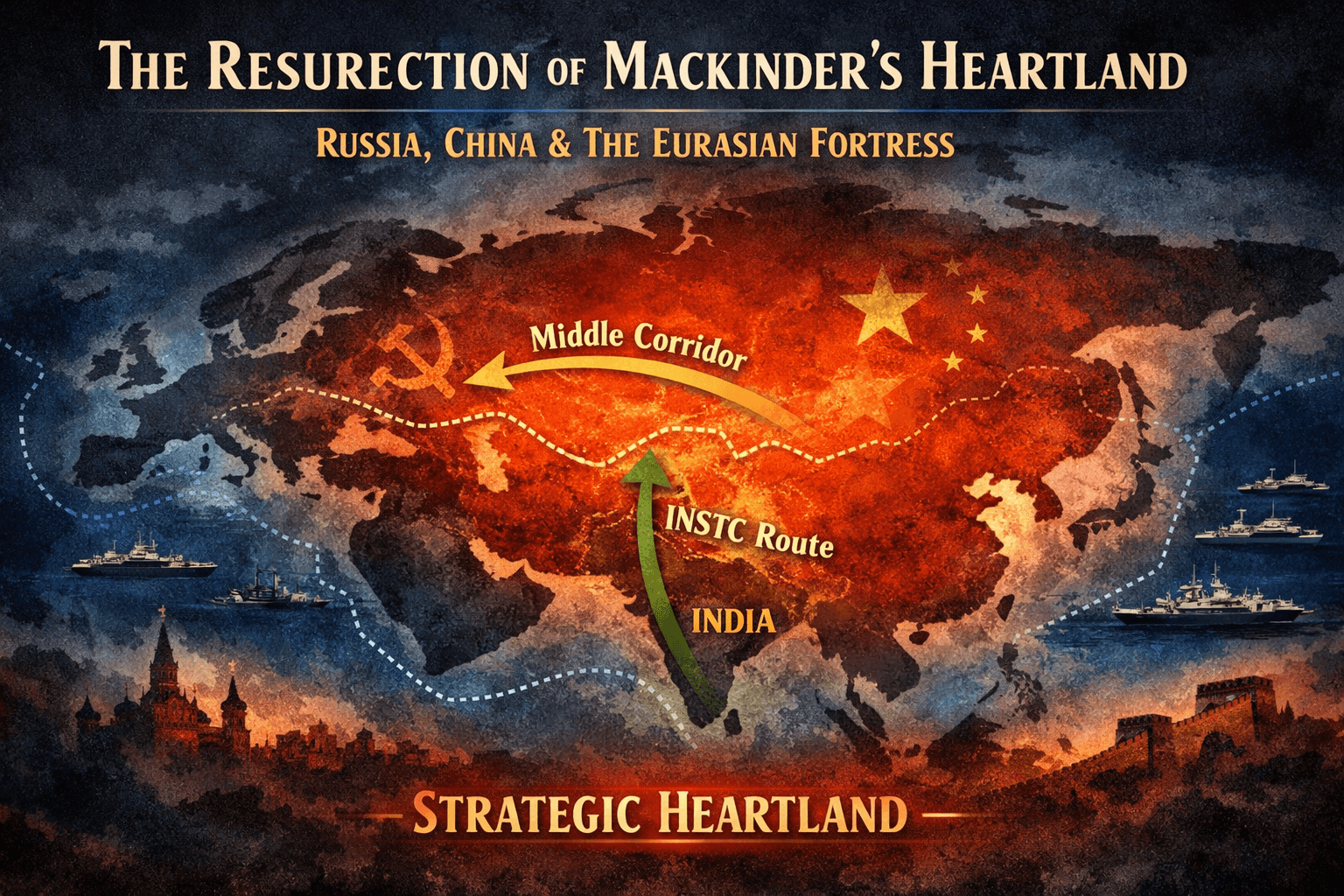
The Resurrection of Mackinder’s Nightmare
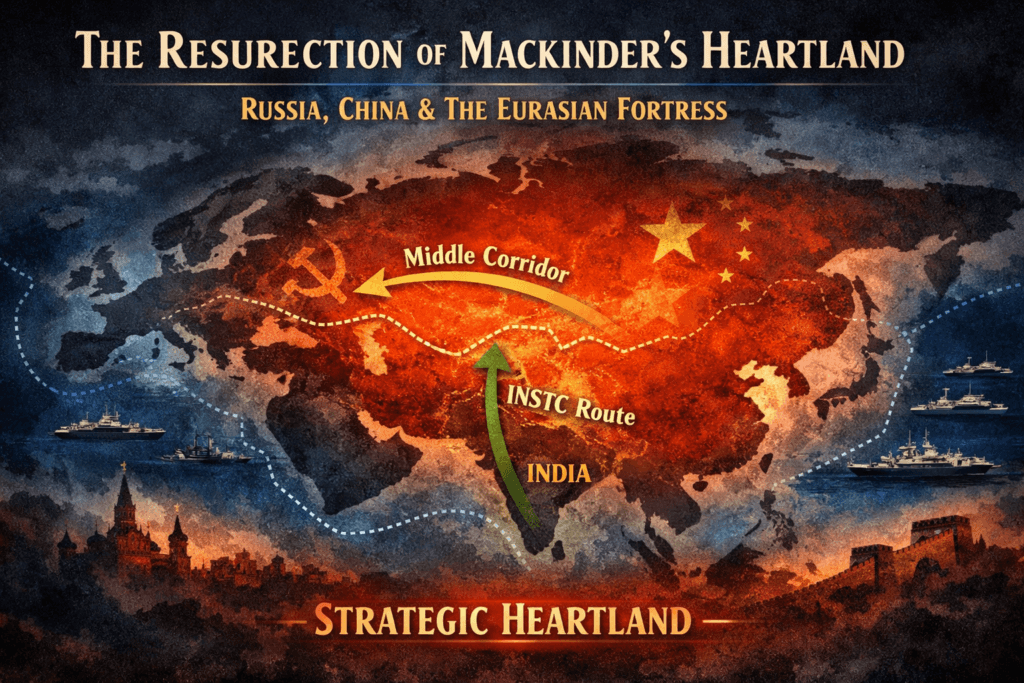
In 1904, the British geographer Sir Halford Mackinder presented a paper to the Royal Geographical Society titled The Geographical Pivot of History. His thesis was stark and terrifying to the maritime powers of the West:
“Who rules East Europe commands the Heartland; Who rules the Heartland commands the World-Island; Who rules the World-Island commands the world.”
For nearly a century, this theory—that the control of the vast interior of Eurasia (Russia and Central Asia) was the key to global hegemony—seemed obsolete. The Cold War was won not by land armies marching across steppes, but by maritime containment, economic isolation, and cultural attraction. The collapse of the Soviet Union in 1991 appeared to be the final nail in the coffin of the Heartland theory. The “World-Island” was fractured, weak, and open for business.
However, the Fracture-Critical era has breathed new life into Mackinder’s ghost. The sanctions regime imposed on Russia following the 2022 invasion of Ukraine has not resulted in the collapse of the Russian state; instead, it has accelerated the formation of a cohesive Eurasian Bloc. We are witnessing the fusion of Russian resource wealth with Chinese industrial capacity, creating a continental fortress designed to be immune to the pressure of Western maritime powers.
[Image of Mackinder Heartland Theory Map]
The Axis of Convenience: A Statistical Fusion
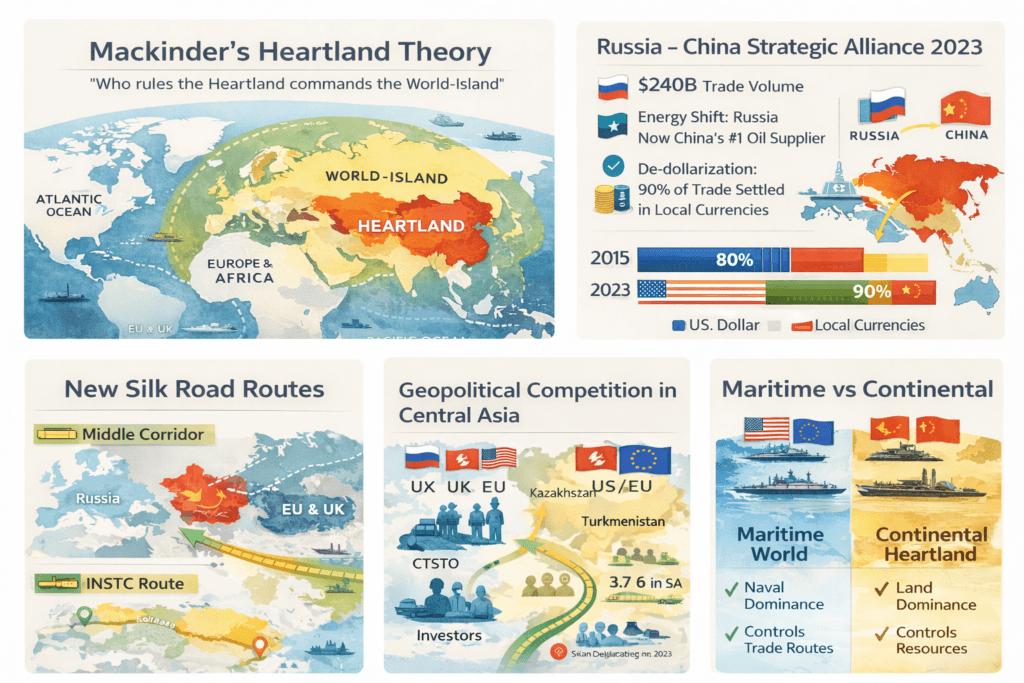
The emerging Russia-China axis is often dismissed by Western analysts as a “marriage of convenience” fraught with historical mistrust. While the mistrust exists, the data tells a story of rapid, structural integration that is hardening into a permanent reality.
The speed of this economic decoupling from the West and recoupling to the East is unprecedented in modern economic history.
- Trade Volume Explosion: In 2023, bilateral trade between China and Russia reached a record $240.1 billion, smashing the $200 billion target a year ahead of schedule. This represents a 26.3% increase year-on-year.
- Energy Shift: In 2023, Russia overtook Saudi Arabia to become China’s top oil supplier, shipping approximately 107 million metric tons of crude. This is not just a commercial transaction; it is a strategic realignment. China secures overland energy supplies that the U.S. Navy cannot blockade in the Strait of Malacca, while Russia secures a lifeline market that Western sanctions cannot touch.
- The Yuanization of the Heartland: Perhaps the most significant blow to Western leverage is the de-dollarisation of this trade. By late 2023, the Chinese yuan had replaced the U.S. dollar as the most traded currency on the Moscow Exchange. Over 90% of trade between the two nations is now settled in their own currencies, effectively rendering the SWIFT payment system irrelevant to their bilateral commerce.
This creates a “sanctions-proof loop”: Russian energy powers Chinese factories; Chinese finished goods (cars, electronics, machinery) flood the Russian market. In 2023, Chinese automakers captured over 50% of the Russian market, filling the vacuum left by the exodus of Volkswagen, Toyota, and Ford.
The War for the Rimlands: Ukraine in Context
To understand the war in Ukraine through a geopolitical lens, one must look beyond the tragic human toll and see the structural conflict. In Mackinder’s framework, Ukraine is a critical section of the “Rimland”—the strip of coastal land that encircles the Heartland.
For the Atlantic Alliance (NATO), controlling the Rimland keeps the Heartland contained. For the Heartland power (Russia), controlling the Rimland is necessary to access warm water ports and push the defensive perimeter westward.
The war has effectively severed the “Land Bridge” that was meant to connect China to Europe via Russia. The “Northern Corridor” of the Belt and Road Initiative (BRI), which sent rail freight from Chengdu to Duisburg via Russia and Belarus, has seen volumes plummet.
- Rail Volume Drop: Container traffic on the main route through Russia dropped by nearly 40% in the year following the invasion as European companies refused to transit Russian territory.
This kinetic severing of ties has forced the Heartland to look South, rather than West, for connectivity.
The New Silk Roads: Bypassing the West
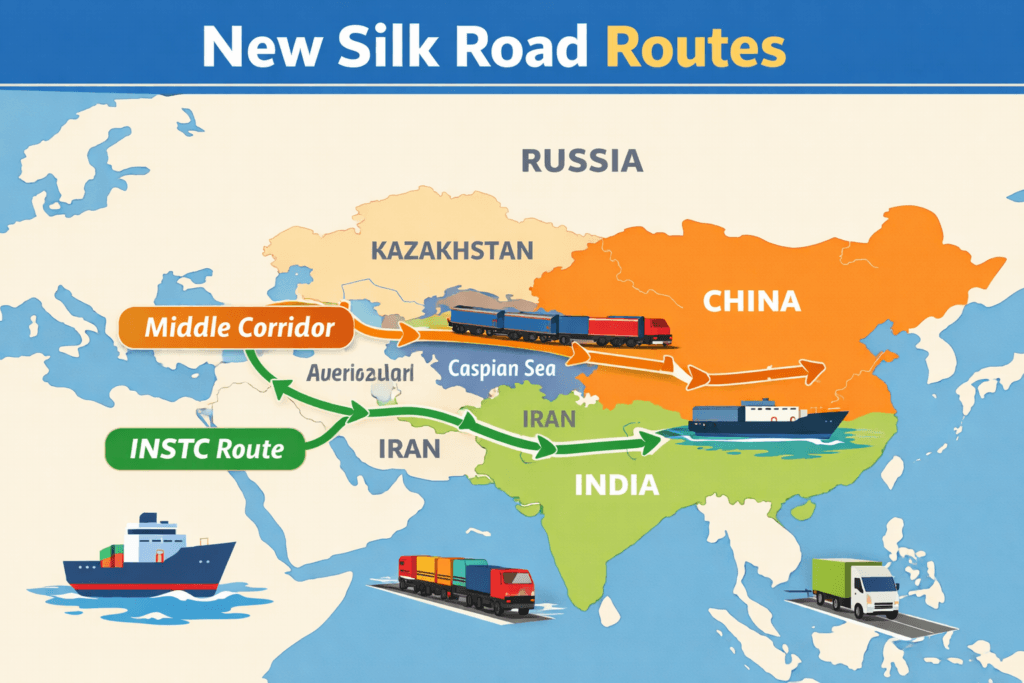
With the Western route blocked, the Heartland is re-plumbing the global trade architecture. Two major corridors are being rapidly developed to ensure the Eurasian fortress can trade with the Global South without crossing Western-controlled waters or territory.
1. The Middle Corridor (Trans-Caspian International Transport Route)
This route runs from China, through Kazakhstan, across the Caspian Sea to Azerbaijan, Georgia, and into Turkey/Europe. It completely bypasses Russia.
- Throughput Growth: In 2022 alone, cargo volume along the Middle Corridor increased by 2.5 times to 1.5 million tons. While this is still a fraction of the Northern route’s capacity, the strategic investment pouring into Caspian ports like Aktau (Kazakhstan) and Baku (Azerbaijan) indicates a long-term shift.
listern to our up and coming pod casts in style

2. The International North-South Transport Corridor (INSTC)
This is the artery of the “Pariah Axis.” It connects Russia to India via Iran. Goods travel by rail from St. Petersburg to Caspian ports (like Astrakhan), ship to Iran (Anzali), rail to the port of Bandar Abbas, and then ship to Mumbai.
- Strategic Value: This route reduces transit time from 40 days (via Suez Canal) to roughly 25 days. More importantly, it is entirely outside the reach of NATO navies.
- Investment: Russia and Iran signed an agreement in 2023 to finance the completion of the Rasht-Astara railway link in Iran, a $1.7 billion project that fills the final gap in this rail network. This corridor allows Russia to trade with the booming Indian market and access the Indian Ocean while bypassing Europe entirely.
[Image of International North-South Transport Corridor map]
The Battle for the “Stans”: The Soft Underbelly
The five Central Asian republics (Kazakhstan, Uzbekistan, Turkmenistan, Tajikistan, Kyrgyzstan) are the literal heart of the Heartland. For decades, they were firmly in Moscow’s orbit. Today, they are the site of a silent but intense geopolitical bidding war.
While Russia remains the security guarantor (via the CSTO alliance) and a key labor market for migrant workers, China has become the economic banker.
- Investment Scale: Since the launch of the Belt and Road Initiative in 2013, China has invested over $50 billion in Central Asian infrastructure.
- Diplomatic Pivot: In May 2023, Xi Jinping hosted the leaders of the five Central Asian nations in Xi’an for a landmark summit—notably without Putin present. The resulting “Xi’an Declaration” promised $3.7 billion in new financial support and deepened security cooperation.
The U.S. and EU are also attempting to re-enter this arena, offering “sovereignty support” to help these nations resist Russian/Chinese pressure. However, geography is destiny here. Landlocked and sandwiched between the Bear and the Dragon, the “Stans” have little choice but to integrate into the Eurasian bloc, even as they attempt to maintain a veneer of multi-vector diplomacy.
Conclusion: The End of the Coastal Era
For 500 years, since the Age of Discovery, global power has been determined by those who controlled the oceans. The British Empire and the American Superpower were thalassocracies—sea powers.
The return of the Heartland Theory signals a challenge to this maritime dominance. The Eurasian Fortress—anchored by the Chinese economy, fueled by Russian resources, and connected by internal rail and pipelines—is an attempt to build a world order that does not need the ocean to survive.
If this integration succeeds, the “World-Island” will contain the majority of the world’s human population, the majority of its natural resources, and the majority of its industrial output. The Atlantic powers would be left on the periphery, looking in. The war in Ukraine is not just a regional conflict; it is the violent friction of these two tectonic plates—the Maritime World and the Continental World—grinding against each other.
Leave a Reply