It began, as all global catastrophes do, with an unusually quiet kettle.
Not the cinematic silence of apocalypse films, where the birds stop singing and the wind forgets how to blow. No — this was domestic silence. The soft, petty silence of a plug that refused to plug, a tap that coughed itself into a philosophical crisis, and a toothbrush that had simply… vanished.
At first, people blamed themselves.
“I must have misplaced it,” someone muttered, rummaging through drawers now filled with an archaeological assortment of metal and ceramic replacements hastily shoved into modern life’s plastic skeleton. But the toothbrush hadn’t been misplaced. It had been erased.
Along with everything else, plastic.
Gone. No warning. No press conference. No committee report. No phased rollout. Just a planetary subtraction: polymer subtraction at scale.
One day, it was everywhere, as invisible as oxygen. Next, it was nowhere, and suddenly oxygen seemed easier to replace.
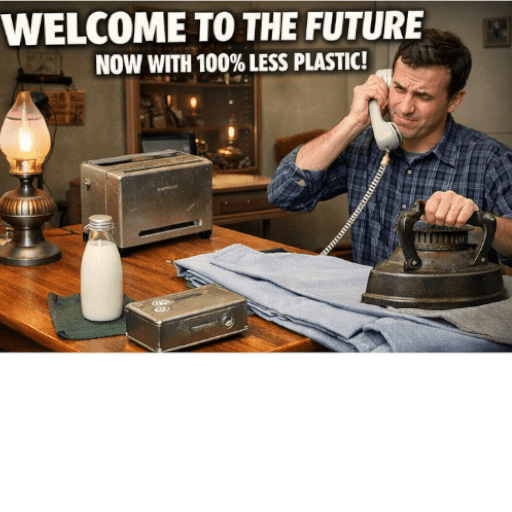
2. A Brief Reminder of How Deep It Went
Before the disappearance, plastic had achieved what most empires dream of: total cultural integration. It was not merely a material; it was an assumption. A background condition. The silent scaffolding of modernity.
Plastic lived in:
- Your phone casing and its microscopic internal insulation
- The lining of food tins (yes, even the “metal” ones)
- Your glasses frames
- The car dashboard
- The wiring inside the walls
- The pipes under the floors
- The coatings on clothes
- The seals on medicine bottles
- The insulation around vaccines
- The paint binder on your walls
- The glue in your furniture
- The keyboard beneath your fingers
Plastic was not the villain in a morality play. It was the stage, the lighting rig, and most of the props.
Remove it, and the play doesn’t become more moral — it simply stops.
3. Industry: The Great Mechanical Shrug
The first industry to notice was manufacturing, because it tried to turn on and found itself made of intentions and exposed copper.
Factories did not explode dramatically. They simply failed to continue existing in a meaningful operational sense. Conveyor belts lost their rollers. Bearings screamed themselves into metallic friction. Seals vanished. Lubricants leaked. Insulation went on strike.
A modern factory without plastic is like a violin without strings: technically still a violin, but largely decorative.
Engineers stood in silence, staring at machines that looked structurally intact yet somehow deeply embarrassed. The plastics hadn’t merely been components; they were the hidden diplomacy between metals — the negotiators that allowed friction to become cooperation.
Without them, everything defaulted back to brute force.
Metal on metal. Heat. Noise. Failure.
The world rediscovered the soundtrack of the Industrial Revolution in about six hours.
4. Transport: The Age of Honest Squeaking
Cars fared worse.
The myth had always been that vehicles were metal beasts — steel, aluminium, rubber. But rubber is, in modernity, mostly polymer theatre. Tyres began shedding dignity immediately. Interior panels disappeared, exposing wiring like mechanical nerves. Seat foam evaporated. Dashboard electronics died in a quiet, embarrassed flicker.
Planes? Let’s just say aviation became an academic discipline again.
Composite materials vanished mid-conversation. Insulation dissolved. Wire coatings disappeared, leaving systems one short circuit away from becoming very expensive gravity experiments.
Airports didn’t descend into chaos. They descended into paperwork. Flights were “temporarily delayed” indefinitely. The departure boards became monuments to polite denial.
Ships remained — stubborn, ancient, metal things — but even they coughed. Navigation systems failed. Coatings that protected hulls from corrosion disappeared, leaving oceans quietly licking iron like patient predators.
The bicycle, meanwhile, experienced a renaissance. Not because it was immune, but because it had the least to lose. Humanity has always loved a fallback option that doubles as moral superiority.

5. Healthcare: The Quiet Horror
If industry groaned and transport sulked, healthcare whispered something far worse: Oh no.
Modern medicine runs on plastic the way blood runs on iron.
Syringes. IV bags. Catheters. Tubing. Sterile packaging. Disposable gloves. Mask filters. Dialysis systems. Blood bags. Prosthetics. Heart valves. Insulin pens. Contact lenses.
Remove plastic, and you don’t get inconvenienced. You get triage on a civilisational scale.
Hospitals turned into museums overnight — not abandoned ones, but transitional ones, where doctors stood surrounded by equipment that had technically survived but functionally retired.
Glass syringes reappeared like ghosts of Victorian medicine. Sterilisation wards expanded overnight. Metal instruments returned, heavier and more permanent, requiring labour instead of convenience.
The irony was brutal: the disappearance that environmentalists had always framed as salvation immediately raised the question of survival.
Disposable medical plastics weren’t born from laziness. They were born from infection.
Single-use means sterile. Sterile means alive.
The planet might have felt morally lighter. Humanity did not.
6. Food: The Collapse of the Supermarket Illusion
The supermarket, that temple of shrink-wrapped abundance, suffered the most theatrical existential crisis.
Without plastic, shelves didn’t empty. They evaporated.
Because the shelves had never been the food — they had been the logistics.
Plastic packaging has allowed food to:
- Travel further
- Last longer
- Survive stacking
- Avoid contamination
- Be portioned for convenience
Remove packaging, and suddenly, food remembers geography.
Bananas begin behaving like bananas again — fragile, local, temporary. Strawberries revert to seasonal luxuries instead of year-round wallpaper. Meat becomes a same-day commitment instead of a refrigerated negotiation with time.
And water — oh, water.
No bottles. No blister packs. No lightweight distribution.
The modern miracle of cheap, portable hydration vanished overnight, replaced by glass, metal, and the rediscovery that weight is a feature of reality.
Convenience died of density.
7. The Home: A Slow Domestic Unravelling
Homes didn’t collapse. They sighed.
The first casualties were invisible: wiring insulation, plumbing seals, pipe linings. Water systems began leaking in philosophical rather than dramatic ways — not bursts, but persistent, annoying admissions of vulnerability.
Many homes discovered that their “copper pipes” were actually plastic in disguise. PEX plumbing, the silent hero of modern construction, simply ceased to exist.
Suddenly, homes built within the last 40 years faced a midlife crisis.
Leaks appeared where none had been imagined. Floors warped. Walls whispered damp secrets. Insurance companies developed migraines in real time.
Electrical systems became historical reenactments. Without insulation, wiring became an act of faith and distance. People rediscovered why electricity had once required ceramic standoffs and cautious respect.
And then came the small domestic betrayals:
- The remote control without buttons
- The fridge that still existed but couldn’t seal properly
- The washing machine that lost its internal organs
- The mattress that forgot how to be soft
Comfort, it turned out, had been foamed into existence.
8. Clothing: The Return of Honest Fabric
The wardrobe revolt was immediate and deeply unflattering.
Modern clothing is a polyester conspiracy masquerading as cotton innocence. Stretch fabrics, moisture-wicking blends, wrinkle resistance — all polymer illusions.
Remove plastic and clothes, remember gravity, moisture, and the audacity of creasing.
Athleisure died first, finally fulfilling its destiny of being neither athletic nor leisurely. Stretch vanished. Elastic waistbands became historical anecdotes. Socks lost ambition. Underwear lost engineering.
People rediscovered wool, linen, and cotton — and with them, the ancient truth that comfort requires compromise.
Raincoats returned to being philosophical suggestions rather than waterproof guarantees. Umbrellas regained relevance. Tailors regained employment.
Fashion slowed down. Ironically, so did fast fashion’s critics, who suddenly realised that “sustainable textiles” often relied heavily on recycled polymers.
Sustainability had always been complicated. Now it was also itchy.
9. Technology: The Sudden Digital Diet
Computers survived in theory but not in spirit.
Plastic had been the silent enabler of electronics — insulating, casing, stabilising, miniaturising. Without it, devices became bulky, fragile, and alarmingly honest.
Phones reverted to something resembling early prototypes: metal, glass, and anxiety. Battery insulation vanished, turning pocket technology into a thermal personality test.
Laptops became desk ornaments. Keyboards lost their resilience. Screens cracked under existential pressure.
The internet didn’t disappear, but it slowed. The infrastructure lost efficiency. Fibre coatings vanished. Connectors degraded.
Data centres, those invisible cathedrals of modernity, discovered that cooling systems and cable insulation had been quietly plastic-dependent all along.
The cloud, it turned out, had been floating on polymers.
And just like that, society rediscovered patience — not as a virtue, but as a necessity.
10. Environmentalists: The Most Complicated Victory Lap in History
Somewhere, someone tried to celebrate.
After all, plastic pollution had been the defining villain of environmental discourse for decades. Oceans are choking on debris. Microplastics in bloodstreams. Beaches turned into petrochemical confetti.
And now, suddenly, it was gone.
No more plastic islands drifting through oceans like shame made visible. No more seabirds filled with bottle caps. No more straws sparking international debates.
But celebrations quickly acquired footnotes.
Because environmental problems are hydra-headed. Solve one and the others lean in closer.
Glass production surged, dragging energy demand with it. Metal mining intensified. Paper packaging devoured forests. Cotton cultivation expanded, drying up rivers.
The absence of plastic didn’t create purity. It created a substitution.
And substitution has a carbon footprint.
The environmental ledger did not balance neatly. It became a spreadsheet of unintended consequences.
Victory, it turned out, is rarely pure. Mostly, it’s just complicated in a new direction.

11. Waste: The Irony of Heavier Guilt
Here’s the cruel joke: plastic had been light.
Annoyingly, persistently, unforgivably light.
Replace it, and waste doesn’t disappear — it gets heavier.
Glass bins filled faster. Metal waste clanged with moral authority. Paper soaked up rain and collapsed into soggy monuments of good intentions.
Landfills became weightlifting arenas. Transporting waste required more fuel. Recycling became more energy-intensive.
We had removed the material that felt morally offensive and replaced it with materials that felt morally righteous — and physically exhausting.
The planet did not applaud. It simply adjusted its accounting.
12. Microplastics: The Ghost That Stayed
And then came the bitterest twist.
Even after plastic vanished, microplastics remained.
Because the disappearance had been forward-looking, not retroactive. The past, as usual, refused to clean up after itself.
Plastic dust still lingered in oceans, soil, air, and bodies. The legacy persisted like background radiation.
So humanity faced the most frustrating paradox imaginable: all the inconvenience of a plastic-free world, with the lingering consequences of the plastic-filled one.
It was like quitting smoking and still coughing.
13. Economics: The Age of Expensive Basics
Plastic had been cheap. Obscenely, gloriously cheap.
That had been its superpower.
Remove it, and suddenly everything costs more — not because companies are greedy (though they remain admirably committed), but because reality is expensive.
Packaging costs rise. Transport costs rise. Manufacturing slows. Durability increases in some places, decreases in others.
The era of disposable everything ends abruptly, not through moral awakening but through economic blunt force.
People start repairing things again, not because they’ve rediscovered craftsmanship, but because replacing things requires a small bank loan.
Planned obsolescence loses its favourite accomplice. Products become heavier, more repairable, and paradoxically more precious.
Capitalism, deprived of its favourite material accomplice, begins experimenting with nostalgia.

14. Culture: The End of Effortless Convenience
The biggest loss wasn’t technological or economic.
It was psychological.
Plastic had been the lubricant of convenience. The material embodiment of “don’t worry about it.”
Single-use items allowed us to outsource consequences to the future. Plastic cutlery meant no washing. Packaging meant no planning. Bottles meant no refilling. Wrap meant no commitment.
Without plastic, life regains friction.
People carry containers again. Shops refill rather than replace. Habits slow down. Decisions become heavier.
The cultural shift is subtle but profound: a move from immediacy to continuity.
You start owning your objects again, and they start owning a small piece of you back.
15. The Unexpected Upsides (Yes, There Are Some)
Let’s be fair. Even disasters occasionally carry accidental benefits, like broken clocks that accidentally keep time twice a day.
Durability returns.
Without cheap polymers, products begin to favour longevity. Metal, wood, and ceramic are less forgiving but more enduring.
Repair culture revives.
Cobblers, tailors, and tinkerers emerge from historical footnotes. Repair shops multiply like stubborn mushrooms after rain.
Local economies strengthen.
Without lightweight global packaging, local production becomes viable again. Food relocalises. Craftsmanship matters.
Aesthetic honesty improves.
Materials begin looking like themselves. Wood looks like wood, not vinyl pretending. Metal looks unapologetically metallic.
Waste visibility increases.
Heavier waste is harder to ignore. Moral abstraction declines when rubbish requires a forklift.
Micro-convenience addiction weakens.
Life becomes less frictionless, which is occasionally another word for more intentional.
But even these upsides arrive with caveats, like silver linings stapled to grey clouds.
16. The Irony of Innovation
Humanity, faced with the absence of plastic, does what it always does: invents something else and immediately regrets it later.
Bioplastics surge. Mushroom composites. Seaweed films. Lab-grown polymers that promise biodegradability and deliver footnotes.
We rediscover that materials science is a long game played with unintended consequences.
Every solution carries a future problem wearing a disguise and waiting politely for its turn.
The cycle resumes, just with different marketing.
17. Generational Divide
Older generations adapt faster than expected.
They remember milk bottles, repair shops, hand-me-downs, and the peculiar resilience of pre-plastic life. For them, the world feels less like collapse and more like a regression with Wi-Fi.
Younger generations, raised in a frictionless ecosystem of disposability, feel the shock more acutely. The loss isn’t just material — it’s experiential. Convenience had been their baseline, not a luxury.
The argument begins immediately: nostalgia versus normality.
Was plastic an aberration or an achievement?
History, as always, refuses to answer cleanly.
18. The Psychology of Absence
What people miss most isn’t plastic itself. No one has ever gazed fondly at a polypropylene fork and felt poetry.
What they miss is invisibility.
Plastic’s greatest achievement was disappearing into function. It allowed modern life to feel effortless because it absorbed complexity.
Without it, effort becomes visible again.
You notice weight. Fragility. Maintenance. Time.
And humans, famously, have mixed feelings about noticing effort.
19. The Moral Aftertaste
In the end, the sudden disappearance of plastic teaches an uncomfortable lesson: problems that look simple from a distance are usually load-bearing.
Plastic had been both villain and scaffold — polluter and enabler, toxin and tool.
Its removal didn’t purify the world. It complicated it.
Moral clarity dissolved into practical ambiguity.
We discovered that modernity isn’t built from good materials and bad ones. It’s built from trade-offs stacked high enough to look like inevitability.
20. The Long Adjustment
Years pass.
The world stabilises, not because it solves the problem, but because humans are astonishingly good at redefining normal.
Children grow up without ever knowing plastic existed. They learn weight as a default condition. They assume repair is natural. They find old polymer relics in museums and ask the same question we ask about asbestos or leaded petrol:
“What were they thinking?”
And the answer, as always, is the same quiet shrug history offers every generation:
“They were solving a different problem.”
21. The Final Irony
If you stand back far enough, the disappearance of plastic becomes less a disaster and more a mirror.
It reflects our dependency on invisible systems. It exposes how convenience hides complexity. It reveals that progress is rarely a straight line — more often a messy spiral where solutions and problems share the same atoms.
And perhaps the greatest irony is this:
Plastic was once the miracle material that made life easier.
Then it became the symbol of everything wrong with modernity.
Then it vanished — and we realised it had been both.
Not a hero. Not villain.
Just material.
And like all materials, it told the truth about us: that we build our worlds from compromises, then spend generations arguing about which compromises were mistakes.
22. A Small, Quiet Epilogue
Somewhere, in a quiet kitchen, someone fills a heavy glass bottle from a tap that occasionally sighs through old metal pipes.
They carry it to the table with two hands, because it has weight now. Real weight.
They sit, drink, and pause.
Not because the water tastes different — it doesn’t — but because the act feels different.
More deliberate. Slightly inconvenient. Faintly meaningful.
And in that tiny pause lives the strange legacy of a world without plastic:
A life with fewer illusions, more friction, and just enough irony to keep us from pretending we ever really understood the bargain in the first place.
Leave a Reply